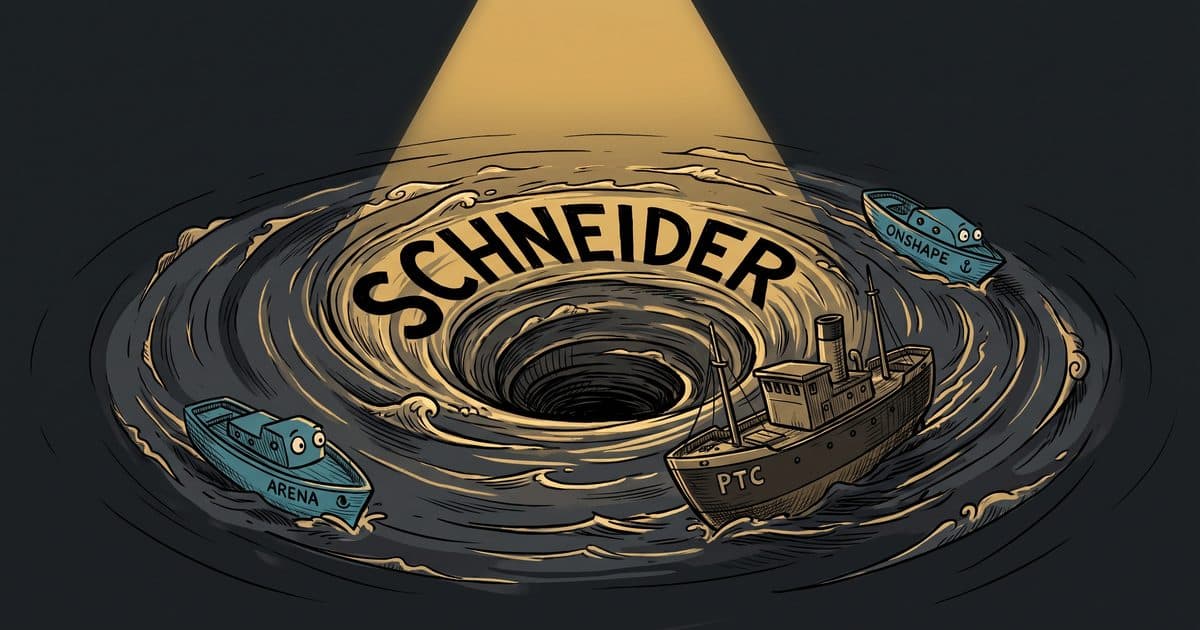
Every hardware tool built for small teams is one acquisition away from forgetting you exist.
On October 5, Schneider Electric agreed to buy PTC for $22.6 billion in cash. PTC owns Arena, the PLM that a generation of hardware startups picked because it wasn't Windchill. It also owns Onshape, the browser CAD tool a lot of early-stage teams are designing in right now. Both are about to become product lines inside a French energy conglomerate.
The press release calls it "the next level of Energy and Industrial Intelligence." Read that sentence again and look for your 12-person team shipping an IoT sensor. You aren't in it.
What Actually Happened
Schneider is paying $205 per share, a 42% premium over PTC's last close, which values PTC's equity at about $22.6 billion and the enterprise at about $23.7 billion. It's the largest acquisition in Schneider's history. Closing is expected by Q3 2027, pending PTC shareholder approval and regulators.
PTC's portfolio comes along whole: Windchill, Arena, Codebeamer, ServiceMax, and FlexPLM on the lifecycle side; Creo, Onshape, and Vuforia on the CAD and AR side.
Nothing changes on day one. Your Arena login works tomorrow. Your Onshape documents are still there. That is precisely why most teams will do nothing, and that is the mistake.
We've Seen This Movie
Arena was founded in 1999 as BOM.com. Its whole pitch was the anti-enterprise PLM: cloud-native, fast to adopt, built for teams that couldn't staff a Windchill admin. PTC acquired it in 2021. Today Arena carries a $10K minimum and a six-week implementation. The tool that disrupted the enterprise became the enterprise. Now it's being absorbed by a bigger one.
Duro ran the same play a decade later. Self-serve, transparent pricing, a working PLM in an afternoon. Then Altium acquired Duro in December 2025, two years after Renesas bought Altium for $5.9 billion. The self-serve trial disappeared. Pricing disappeared. Every tier now starts with a demo call.
Stratasys bought GrabCAD in 2014. Workbench, the free PDM tool thousands of small teams used to version their CAD, was shut down in June 2023. Those teams got a migration deadline.
And then there's Arduino.
Arduino Is the Warning Shot
Qualcomm announced it was acquiring Arduino in October 2025. Arduino is the reason a lot of us are hardware engineers at all. It's open hardware, open schematics, hack-it-yourself by design.
Within weeks, Arduino's new terms of service banned reverse engineering of its cloud platform and claimed a perpetual, irrevocable, sublicensable license to whatever users uploaded. The terms also added language on monitoring AI usage and barred users from using the platform to look for patent infringement by Arduino or its partners.
Adafruit called it a break from the open-hardware ethos that built the platform. Their founders asked the obvious question: why is reverse engineering prohibited at all for a company built on openly hackable systems?
Arduino's answer was that the restrictions apply only to its SaaS cloud apps, and that the IDE, schematics, and libraries remain open source. That's true. It's also beside the point. The community didn't get mad because a license changed; they got mad because the company stopped acting like it was on their side. Trust doesn't live in the license file.
A company built on hackable hardware started writing terms against hackers. That is what a mission shift looks like from the outside.
Acquired Tools Don't Die. They Get Benched.
The failure mode is rarely a shutdown announcement on day one. It's slower than that, and it follows a script.
The roadmap starts following the acquirer's biggest accounts. Integrations with the parent company's ecosystem get prioritized; integrations with everyone else go quiet. The pricing page turns into "contact sales." The free tier gets a usage cap, then a time limit. The support team that used to answer your Slack messages gets folded into an enterprise ticket queue.
None of this is malicious. It's math. Schneider is paying a 42% premium, and that premium gets recovered from customers who sign seven-figure contracts, not from startups paying a few hundred dollars a month. When the acquirer's strategy deck says "energy and industrial intelligence," the product teams inside it get measured against that deck.
The mission that won you over turns into a slide in someone else's presentation.
You Don't Own Your Product Data. You're Renting It.
Here's the question to answer this week, not in Q3 2027: can you export your BOMs, your full revision history, your ECO records, and your CM packages, cleanly, tomorrow, without filing a support ticket?
Not "is there an export button." Actually run it. Then open the file and check three things:
- Is the revision history in there, or just the current BOM? A BOM without its history is a snapshot; the history is what tells your CM which revision they built.
- Are your ECOs in there, with what changed, who approved it, and which assemblies were affected? If your change orders only exist inside the tool, your audit trail belongs to the vendor.
- Can you import it somewhere else without a consultant? If the export is a proprietary format or a 40-tab spreadsheet nobody can parse, it's not an export. It's a hostage note.
If the answer to any of those is no, the acquisition isn't your risk. Your data architecture is.
Why We Built oroForge the Way We Did
I'm going to be direct about our bias here: oroForge competes with Arena and Duro, and this is the moment to say why we exist.
We're founders from the startup world. We've shipped hardware out of small teams, sent the wrong files to a CM, and lived through the spreadsheet chaos that PLM is supposed to fix. We built oroForge because the tools available to us were either spreadsheets or enterprise contracts, and every startup-friendly option eventually got bought and repointed at bigger customers.
oroForge is a public benefit corporation. Serving hardware startups and SMBs is written into our legal structure, not just our marketing copy. That means our board is obligated to weigh the mission alongside the return, and it's harder to quietly trade away the customers we were built for.
Builders building for builders. Here's what that looks like in practice:
- Pricing you can see. A permanent free plan, and a Team plan at $50 per month for 10 seats. It's on the pricing page, not behind a demo call.
- No sales wall. You sign up and start working the same day. No implementation consultant, no six-week rollout.
- Your data leaves when you want it to. Export a single BOM as CSV or ZIP, or export every BOM in a project as an XLSX file, whenever you want, without asking anyone.
We can't promise you nobody will ever make us an offer. Nobody can promise that. What we can promise is that the mission is in the charter, the pricing is public, and your data is never locked in. If we ever stop serving you, you'll be able to walk out the door with everything.
If you're on Arena or Onshape, you don't need to panic and you don't need to migrate tomorrow. You do need to know where your exit is. And if you're about to pick a PLM for the first time, pick one whose mission is you.
Sources
- PTC Investor Relations: Schneider Electric to acquire PTC, creating the next level of Energy and Industrial Intelligence (October 5, 2026)
- Bloomberg: Schneider Expands in AI With Record $23 Billion Acquisition (October 5, 2026)
- The Register: Schneider Electric acquires PTC for $22.6 billion (October 5, 2026)
- Beyond PLM: Schneider Electric PTC Acquisition: What It Means for PLM (October 5, 2026)
- The Register: Makers slam Qualcomm for tightening the clamps on Arduino (November 21, 2025)
- TechSpot: Qualcomm rewrote Arduino's ToS, and the community is not taking it well (November 2025)
- It's FOSS: Enshittification of Arduino Begins? Qualcomm Starts Clamping Down (November 2025)
- Open Source For You: Arduino Criticised For User Monitoring And Patent Shielding (November 2025)