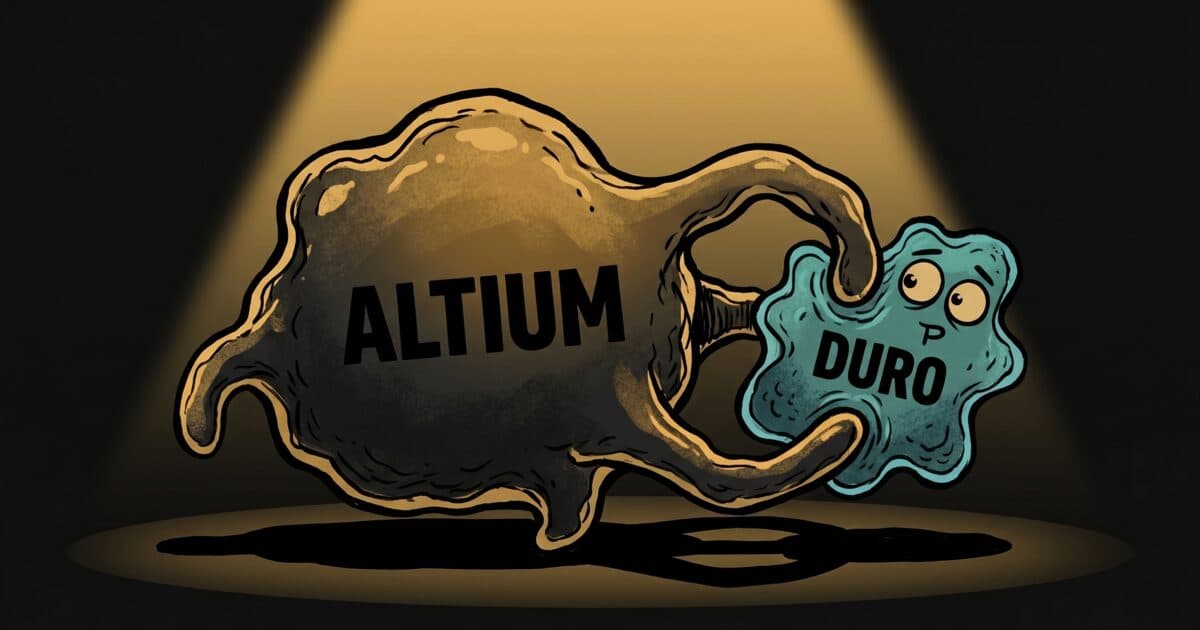
Duro earned its reputation the hard way. Hardware founders at 5 to 30-person teams chose it because it was self-serve, transparent, and fast to set up. No sales call, no implementation consultant, no six-week rollout. You could sign up, import your BOM, and have a working PLM in an afternoon.
That version of Duro no longer exists.
On December 5, 2025, Altium acquired Duro Labs. Altium itself was acquired by Renesas Electronics in 2024 for $5.9 billion. Duro is now two acquisitions deep inside a Japanese semiconductor company, and its pricing page shows exactly what that means: every tier requires a demo call before you can see the product, and no pricing is published anywhere.
Self-Serve Is Gone. So Is Transparent Pricing.
Before the acquisition, Duro offered a self-serve trial. You could evaluate the product on your own timeline without talking to a sales rep. That access is gone. Every plan, including the entry-level Team tier for up to 10 users, now requires you to book a demo before you see anything.
Pricing is undisclosed. Third-party aggregator sites estimate a starting price around $450 per month, but Duro does not confirm that figure. You will get a number after the sales call, not before.
PDM has also been separated into its own product called Duro Drive. On the base Team tier, you get BOM management and change management. File storage and version control for CAD files require upgrading to Business. PDM is not a premium feature; it is the layer that makes PLM work. Revision control and file versioning are what prevent your mechanical engineer and your electrical engineer from overwriting each other's work. Separating them from the base tier is a packaging decision that serves enterprise sales, not a 12-person startup where the founder is also writing ECOs.
The Altium ownership adds a roadmap risk that is harder to quantify but easy to predict. Duro's deepest integration was always with Altium 365, for obvious reasons given the prior partnership. Now that Altium owns the product, the incentive to push users toward Altium's CAD ecosystem and away from SolidWorks, KiCad, or Fusion 360 is structural, not incidental. Altium's roadmap will serve Altium customers first.
Duro Now Sells Like the Tool It Was Built to Disrupt
Duro was good at a specific thing: getting a 5 to 20-person team off spreadsheets without disrupting how they already worked. You didn't have to configure approval chains before your first prototype shipped. You didn't have to schedule a demo to find out whether the interface made sense for your workflow.
The sales-led model ends that. When you have to book a call to evaluate a tool, you are committing time before you have seen whether the product fits. For a founder or ops lead at a small team, that is not a trivial cost. It also signals how the vendor thinks about your size of company.
Arena PLM, which Duro was explicitly built to disrupt, also requires a sales conversation before pricing. Arena starts at roughly $1,200 to $2,500 per user annually, which puts a 10-person team at $30,000 to $45,000 per year before implementation. Duro now sells the same way as the tool it was built to replace. (How oroForge compares to Arena →)
Who Should Still Consider Duro
Duro is not a bad product. The UI is genuinely cleaner than Arena, and the CAD integrations with SolidWorks, Altium 365, and Siemens NX are deeper than most alternatives at this price range. If your team is in the 20 to 60-person range, already runs Altium 365, and is comfortable with a sales-led procurement process, Duro is still worth evaluating.
The acquisition does not change the product overnight. Existing customers on annual contracts will not see immediate disruption. Your medium-term question is what Duro's roadmap looks like in 12 to 24 months under Altium's priorities, and whether that roadmap still serves a team your size or gets pulled toward Altium's enterprise customers.
For a team under 20 people that wants to see a PLM before committing to it, the demo-required model is a real obstacle, independent of product quality.
What Actually Matters When You're Evaluating Alternatives
The criteria that made Duro worth considering in the first place are still the right filter. Can you access the product without a sales call? Is pricing published before you talk to anyone? Does PDM come included at the base tier, or is it an upsell? Is the vendor's roadmap shaped by customers your size, or by a parent company with different priorities?
CAD coverage is the other question to ask directly. Most hardware startups today work across both mechanical CAD and electrical CAD: SolidWorks or Fusion 360 on one side, KiCad or Altium on the other. A PLM that connects to only one of those environments leaves the other side in spreadsheets. That is the exact problem PLM is supposed to solve.
ECO enforcement is worth thinking about separately from BOM management. Enforcing formal change-control workflows from day one sounds like discipline; for a team still running prototypes, it is process overhead before you have the throughput to justify it. The right time to turn on ECOs is when your team has outgrown Slack-based approvals, not on the day you sign up for a PLM. A tool that gives you that choice is meaningfully different from one that doesn't. (More on what a minimum viable ECO actually needs.)
The Same Story, Again
Arena was founded in 1999 as BOM.com, targeting exactly the same early-stage hardware teams Duro targeted. PTC acquired Arena in 2021. The tool that disrupts the enterprise eventually becomes the enterprise. That is not a criticism of Duro or the people who built it; it is how venture-backed software companies are structured to exit.
What it means for your team: the window when a tool is both capable and startup-accessible tends to be narrow. Duro's window closed in December 2025.
oroForge is a public benefit corporation. The mission is not just to sell PLM software; it is to help more hardware startups succeed, because more hardware startups succeeding is good for manufacturing, good for innovation, and good for the broader economy. That is written into the company's legal structure, not just its marketing copy.
That framing shapes how the product is built. Transparent pricing, a permanent free plan, and no demo wall are not sales tactics; they are what it actually looks like to serve early-stage hardware teams instead of extracting from them.
If you want a PLM you can access today, with pricing you can see before you talk to anyone, oroForge has a permanent free plan and a 10-seat team plan at $50 per month. No demo required. See pricing →