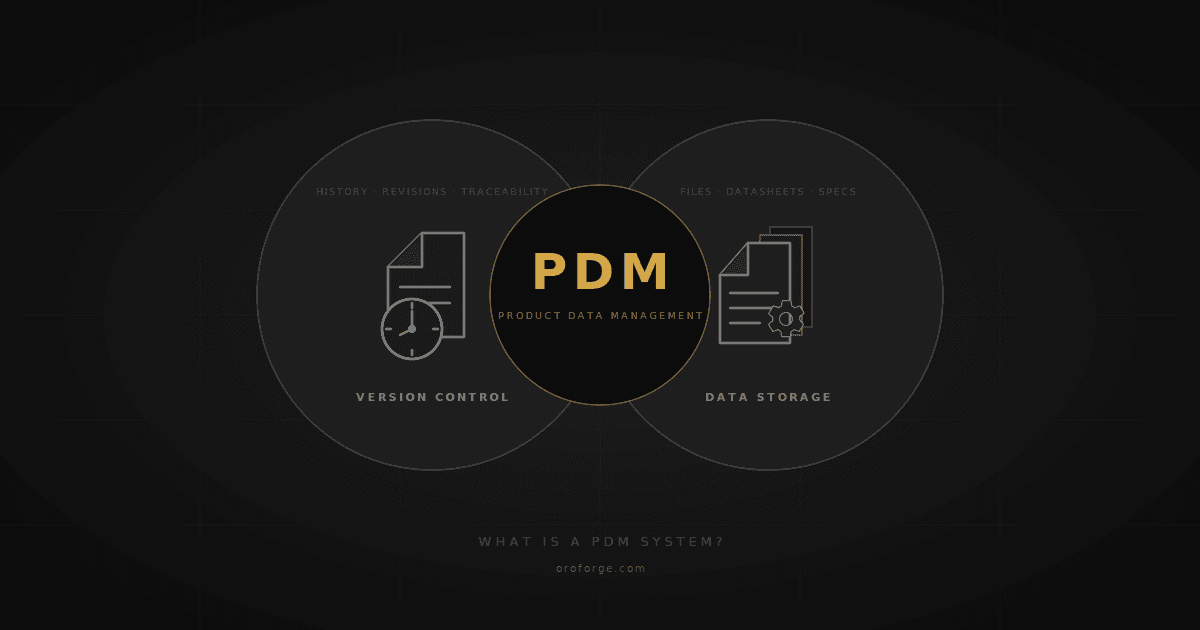
A colleague and I got into a disagreement about what a PDM actually is.
He focused on version control: every change to a CAD file tracked, timestamped, and reversible. Full revision history. The ability to go back to exactly what your product looked like six weeks ago. That's what PDM meant to him.
I kept coming back to something simpler: a place to put the files. Not just CAD geometry, but the STEP exports, the datasheets, the test certs, the supplier specs. A BOM tells you what parts you have. A PDM is where the actual engineering data for those parts lives.
We were both right. And that disagreement is worth unpacking, because if you're a hardware founder trying to figure out what you actually need, the answer depends on which problem is hurting you right now.
Your BOM Can't Hold Engineering Data
A BOM is a list. It tells you part numbers, quantities, references, and descriptions. It does not store a STEP file. It cannot attach a datasheet. It has no mechanism for linking the 3D geometry of an assembly to the spec sheet for the connector on pin 14.
That gap is where PDM starts. Product Data Management is the layer above your BOM: a central repository where your engineering files, documents, and design artifacts live, organized by product structure, and accessible to the people who need them.
The version control part matters too, but it's downstream of this. Before you can track changes, you need a single place where the canonical version actually lives.
The Version Control Half
Once you have centralized storage, versioning becomes the second job.
Not every change to a design needs a flag. Your mechanical engineer will iterate a bracket geometry fifteen times before it's worth anyone else's attention. That's normal; that's how CAD work goes.
But when a change is real, when it crosses the line from "working in progress" into "this is what we're building," it needs to be codified. Centralized. Visible. The rest of the team needs to know this is the approved version, not the one from two weeks ago. Your contract manufacturer needs to know they're building from the right files. And if something breaks in production, you need the traceability to work backward and find exactly when that change happened and who approved it.
That's the version control argument, and it's a strong one. The point is not to track every keystroke. The point is that when something enters your shared engineering record, it's unambiguous, it's complete, and it's tied to a moment in time.
The Problem No One Talks About: Multi-CAD Reality
Here's where most PDM definitions fall apart for hardware startups.
The traditional PDM story assumes you have one CAD environment. SolidWorks PDM works beautifully if your whole team is in SolidWorks. Autodesk Vault integrates cleanly with Fusion 360 and Inventor. Onshape has version control built directly into the platform.
But your product is not just mechanical.
If you're building a robotics controller, an IoT device, a medical wearable, or anything with a circuit board inside it, you have at least two CAD environments in play. Your mechanical team is in Onshape or SolidWorks. Your electrical engineer is in Altium, KiCad, or Eagle. And those systems do not talk to each other. Their internal PDMs certainly don't.
So you end up with mechanical files version-controlled in one place and electrical schematics version-controlled somewhere else, and nobody has a single view of the complete product. When your CM asks for the latest design package, someone has to go collect files from two different systems, reconcile the versions, and hope nothing was missed.
That is not a PDM. That's a FrankenZip.
What a Minimum Viable PDM Actually Looks Like
For a hardware startup between 5 and 25 people, stitching together multiple PDMs is how you end up with the same fragmentation problem you were trying to solve. And standing up an enterprise PLM like Arena or Windchill isn't the answer either: the implementation cost and complexity are built for teams ten times your size. (The BOM management software landscape covers how the tiers break down.)
You need one system that does four things: stores mechanical CAD files organized by product and revision, stores electrical CAD files and board layouts the same way, attaches non-CAD data like STEP exports, datasheets, test reports, and supplier documentation, and surfaces one unambiguous version of the complete product that your whole team and your suppliers can point to.
A mechanical-only PDM solves half the problem. A folder structure in Dropbox with a naming convention solves neither half reliably.
Why This Is Also a PLM Question
PDM and PLM are not the same thing, and the industry does a poor job of explaining where one ends and the other begins. There's a detailed breakdown of PDM vs PLM here if you want the full picture.
PDM is primarily an engineering team's tool. It manages the files and their history. It is concerned with design data: what the thing looks like, what it's made of, what changed and when.
PLM is broader. It connects design data to everything downstream: the BOM your operations team manages, the change orders that control when and how design updates get released to manufacturing, the supplier handoffs, the cost tracking, the compliance documentation. PLM is the system of record for the entire product, not just the CAD files.
For a small hardware team, the honest framing is this: you need both, and you probably can't afford the overhead of implementing them separately.
oroForge as Minimum Viable PDM + PLM
This is the problem oroForge is built around.
Most PDM tools are sold inside a CAD vendor's ecosystem and stop at the engineering boundary. Most PLM tools are priced and scoped for companies with dedicated IT and implementation budgets. Neither is designed for a 12-person hardware startup that uses Onshape for mechanical design and KiCad for electrical, ships to a contract manufacturer in Guadalajara, and needs a single source of truth that everyone can actually use.
With oroForge, your mechanical and electrical data lives in one place, linked to a structured BOM. When a change is significant enough to affect manufacturing, it goes through an ECO: documented, reviewed, and released. The history is there. The traceability is there. Your CM sees one version of the product, not a zip file of files gathered from four different places.
Not every change needs to be an ECO. But the ones that matter, the ones that could break something downstream, get the treatment they deserve.
That's the minimum viable PDM. It also happens to be the minimum viable PLM.
If you're trying to get your hardware team's engineering data under control, oroForge is worth a look. See pricing →