You were never going to own a factory.
Every hardware startup already runs on the model the rest of manufacturing is just now writing reports about. You design in Onshape or SolidWorks, lay out the board in KiCad or Altium, send files out, and somebody else's machines make your product. Access, not ownership, has been your operating plan since the first prototype.
Xometry's 2027 Manufacturing Outlook puts that shift at the center of its thesis: "access is overtaking acquisition as the leading pathway to growth." It's a good report. It's also a report about one slice of your product, and the slice it leaves out is where startups actually get hurt.
What the Report Actually Measured
The survey covers 150 US manufacturing executives, run by John Zogby Strategies in August 2026, plus a survey of 189 shops in Xometry's partner network and Xometry's own order data.
Two caveats. The overall margin of error is plus or minus 8 points, and the industry and revenue breakouts rest on 30 to 55 respondents each; the report itself says to read them directionally. And Xometry sells access to manufacturing capacity, so "buyers should use more suppliers" is also a sales pitch.
The more important limit is scope. The report's data and examples are about custom parts: CNC machining, sheet metal, certified aerospace components. That's Xometry's business, connecting buyers who need a handful of different parts with the shops that can make them. It says nothing about the board inside your enclosure, or who puts the two together.
Your Product Has More Than Parts
Most hardware shipping today has a PCB in it. Electronics went through the same digital shift years ago, and arguably went further.
JLCPCB and PCBWay will instantly quote a bare board and a populated one in a browser, pulling parts from their own stocked libraries. CircuitHub does the same for assembly in the US. Upload Gerbers, a centroid file, and a BOM; get a price and a ship date without talking to a salesperson. Nobody calls anybody.
Then the parts have to become a product. Somebody has to take the enclosure from the machine shop, the board from the assembly house, the cable harness, the battery, the flashed firmware, and the packaging, and turn them into a unit that passes test and goes in a box. That's final assembly, sometimes called box build. Sometimes your PCBA house does it. Sometimes it's a separate CM. Early on, it's often your own bench.
So a modest IoT device in production can easily involve five vendors: a mechanical shop or two, a board fab, an assembly house, a final assembler, and the cable supplier. Xometry's own data says its customers with six-figure annual spend had their 2025 work fulfilled by an average of 15.3 suppliers. That's for mechanical parts alone.
Every Vendor Got Easier. The Product Didn't.
Instant quoting solved the per-vendor problem. Getting a price on a sheet metal bracket or a four-layer board is now trivial.
None of those quotes covers the space between vendors. The machine shop doesn't know that the PCB moved a USB-C connector 2 mm in rev D, so the enclosure cutout it's about to cut 500 of is wrong. The assembly house doesn't know which firmware image to flash unless someone tells it, and it definitely doesn't know the image changed on Tuesday. The final assembler is waiting on both, and it builds whatever shows up.
Every one of those failures is a revision mismatch across a vendor boundary. No single vendor can catch it, because no single vendor sees the whole product. The only party that does is you.
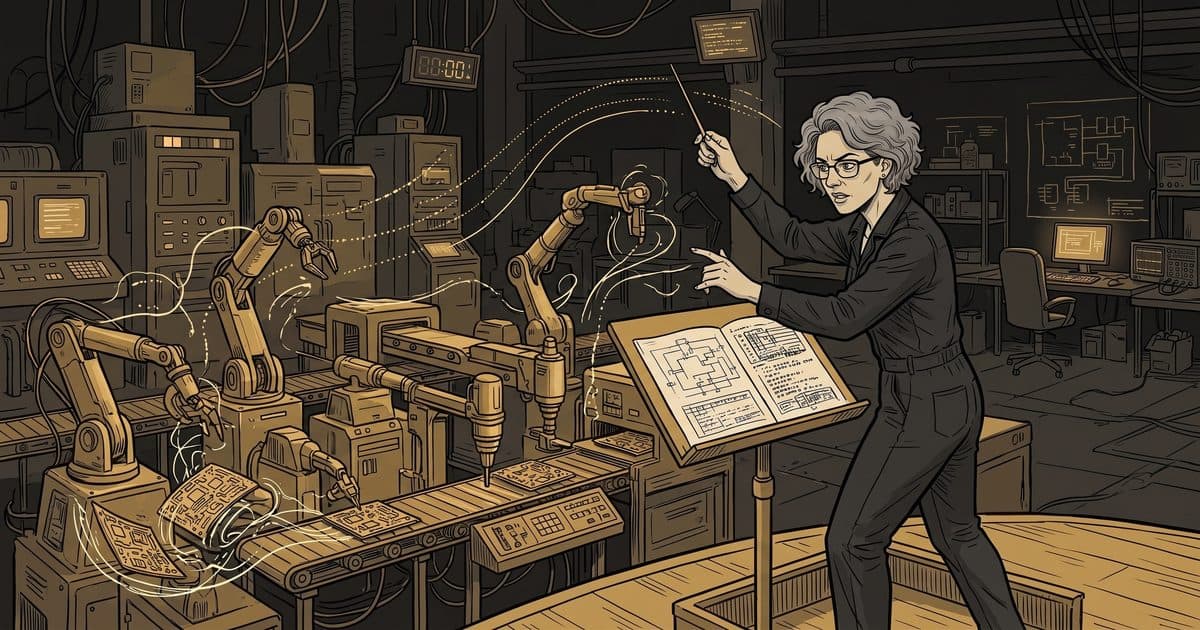
You Stop Being the Engineer and Start Being the Orchestrator
Here's the part the report circles without saying, because it's written for factories: once a hardware startup reaches production, its job changes.
Through EVT and DVT, you're an engineer. You're designing parts, picking components, fixing what broke on the bench. By PVT and into production, most of the engineering is done, and the work becomes coordination. Which revision is each vendor building? If the board changes, which other vendors does it touch? What does the full unit cost today, across five quotes taken on five different dates? Which supplier is holding up the build, and is there an alternate?
That's product management, in the most literal sense. You're managing the product across its lifecycle and across everyone who builds a piece of it.
Which is exactly what product lifecycle management means. The name isn't enterprise decoration. Startups tend to dismiss PLM as bureaucracy built for 200-person engineering orgs, and the enterprise tools earned that reputation. The underlying job is real, though, and it lands on every hardware team the moment it has more than one vendor: keep one source of truth for part numbers, revisions, BOMs, and changes, and make every handoff pull from it.
A CM handoff is already more than a BOM. Orchestration is that handoff, repeated across every vendor, every time anything changes. That's why the engineering change order matters more in production than in design: it's the one document that tells every affected vendor the same thing at the same time.
AI Is Moving Upstream. It Still Sees One Vendor at a Time.
The report's headline AI finding: 51% of manufacturers expect AI's biggest 2027 impact in manufacturability and costing. Quality control follows at 47%; production execution on the shop floor trails at 32%. Around 65% already use general-purpose tools like Claude, ChatGPT, and Gemini for DFM review, and the report admits those tools lack the supplier production history and pricing data that make answers trustworthy.
All true. But every one of these AI tools sees one vendor's slice. The machining DFM check sees a STEP file. The PCB house's DRC sees Gerbers. Neither knows the other exists, and neither knows which revision of the product the slice belongs to.
Xometry's CTO puts it well in the report: "Scale without a feedback loop plateaus." That's the argument we made about why AI agents need feedback loops. For a multi-vendor product, the loop that matters isn't inside any one vendor's quoting tool. It's the one that checks whether everything you've sent out still describes the same product.
Rising Prices and Certifications Multiply Across Vendors
Ninety-four percent of manufacturers expect to raise prices in 2027, and two-thirds say pricing is harder to forecast than a year ago. Raw materials (26%), tariffs (21%), and labor (20%) are the drivers; only 11% cite competitor pricing.
With one vendor, a stale cost is a nuisance. With five, your unit cost is a sum of quotes taken at different times under different tariff assumptions, and nobody can tell which line is current. Every cost on the BOM needs a source and a date; a number with no provenance looks exactly like a number you can trust.
Certifications compound the same way. On Xometry's platform, certification-required work generated about 3.4 times the job value of non-certified work in 2025, and about two-thirds of aerospace and defense orders now carry at least one certification or compliance requirement. If you build for defense or medical, those requirements have to flow down to each vendor that touches the part, not live in one engineer's memory.
Certification also runs in the other direction. Your product's own certifications, FCC, UL, CE, or an FDA clearance, describe one specific version of it. Swap the antenna, change the enclosure plastic, or move to a different power supply, and you may owe your test lab or certification body a notification, a permissive change filing, or a full retest. The vendor who made the change won't tell them; they don't know the certification exists. That's one more party your change process has to reach, and the one that's easiest to forget, because you only talk to them once a year.
The workforce data points the same direction. Seventy-seven percent of manufacturers report bigger backlogs than a year ago, and only 59% plan to hire. A shop with a growing backlog and flat headcount prioritizes customers who are easy to work with: clean packages, no confusion about which revision is current, no surprise changes after the quote. Being an easy customer is a sourcing strategy now.
Where oroForge Fits
Right now, oroForge is a minimum viable PLM for startups and small hardware companies: one place for part numbers, BOMs, revisions, and change orders, without a six-week implementation or an enterprise price tag. That's the source of truth every vendor handoff should pull from, and it's the piece most teams are missing when they hit production.
The next question is the one this report sets up. If every vendor now has AI on its side of the handoff, the startup needs it on its side too: something that knows which revision each vendor is building, notices when a board change breaks an enclosure that's already on order, and tells you which vendors, and which certifications, an ECO actually touches. That's the orchestration problem, and it's what we're working on next.
The factories got easier to reach. Your board house, your machine shop, and your assembler still don't talk to each other. Someone has to, and in production, that's your whole job.