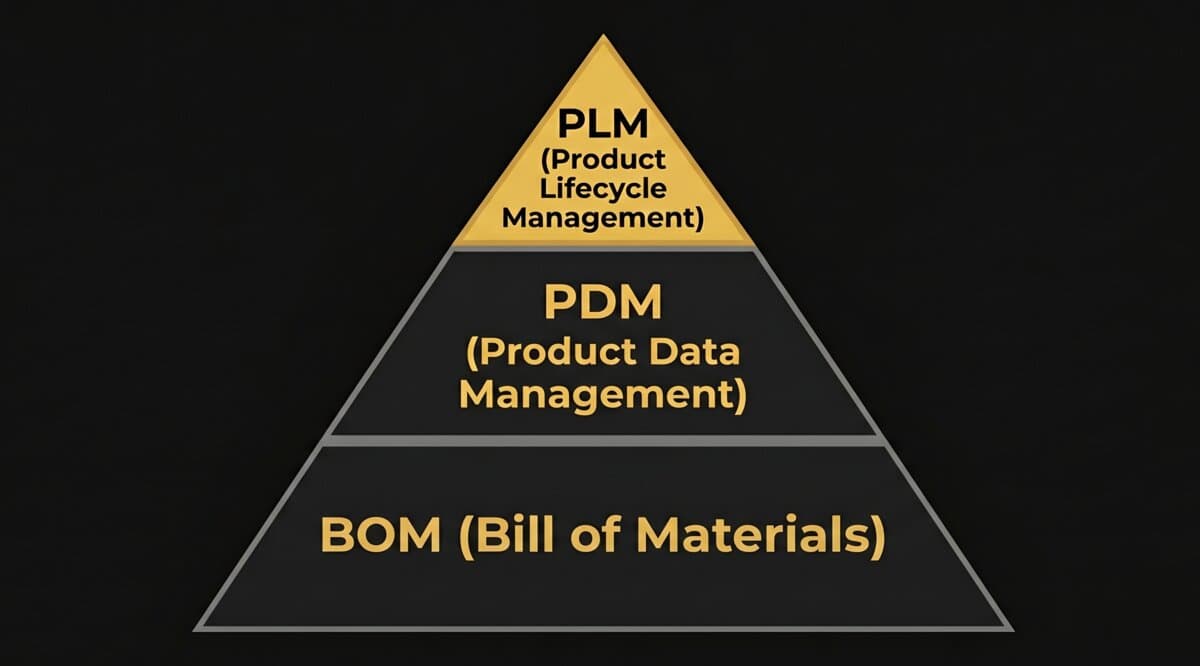
Someone told you that you need a PLM system. Maybe you looked at Arena or Windchill, saw the pricing, and closed the tab. Maybe you're still managing your product in spreadsheets and wondering if there's something in between "total chaos" and "six-figure enterprise software."
There is. But first you have to understand what these three acronyms actually describe, because they are not the same thing, and the industry does not go out of its way to make that clear.
Your BOM Is a Recipe, Not a Row in a Spreadsheet
The bill of materials is the foundation. It is the complete list of every part, component, subassembly, and material that goes into your product: quantities, specs, part numbers, revision levels, and supplier references. If your product is a robot arm, the BOM is the recipe for building it.
That framing matters. A recipe is not just a list of ingredients; it is a precise, versioned document that determines whether what comes out of manufacturing matches what engineering designed. A wrong quantity, a missing part number, an outdated revision — any of those errors downstream can mean a failed prototype, a delayed shipment, or a costly rework.
Your BOM is the source of truth for your product. Everything else in this article is built on top of it.
PDM Is Where the Files Live
Product Data Management is one layer up from the BOM. It manages the engineering data that defines your product: CAD files, step files, datasheets, drawings, specifications, and revision histories.
Think about what actually happens when your team designs a part. An engineer models it in Onshape or SolidWorks. That model has a file. That file has a version history. When the design changes, you need to know which version is current, who changed it, and what it affects. PDM handles that. (What a PDM system actually looks like in practice →)
Here is where BOM and PDM overlap in practice: a BOM without its supporting files is incomplete for manufacturing. If you are sending a package to your contract manufacturer, your BOM references parts that need step files to be machined, datasheets to be sourced, and drawings to be inspected against. The BOM is the recipe; PDM is where the actual ingredient specs live.
For most small hardware teams, this overlap is where spreadsheet-based BOM management starts to break. You can track part numbers in a sheet; you cannot cleanly attach versioned files, manage revisions, or control who has access to what.
PLM Is Where Process Enters
Product Lifecycle Management is broader than PDM, and the word "lifecycle" is doing real work in that name. PLM is not just about managing files or tracking parts; it is about managing what happens when things change.
The core addition that makes PLM different from PDM is change management. Specifically: engineering change orders. An ECO is the formal process for capturing a design change, documenting the reason, defining the impact across the BOM and affected assemblies, getting the right approvals, and closing the loop so manufacturing knows what version to build from.
Without an ECO process, changes happen in Slack. Someone sends a message that part X is being swapped for part Y, three people read it, two act on it, one misses it, and your CM builds from the wrong revision. That is not a hypothetical; that is Tuesday at most hardware startups.
A minimum viable PLM for a startup looks like this: BOM management, the ability to attach supporting files and datasheets, and a structured ECO process to track and approve changes. That is the floor. If you have those three things working together, you have what you need to scale from prototype to production without losing your mind.
Where PLM Becomes a Problem
Here is what the enterprise PLM vendors did: they built the foundation above, then kept adding.
Supplier portals. Quality management workflows. Compliance tracking. Regulatory submission modules. Configuration management trees complex enough to model a commercial aircraft. The tools that were supposed to organize your product data became the product themselves.
Arena, Siemens Teamcenter, Oracle Agile PLM: these platforms are not bad tools. They are tools built for Boeing, Medtronic, and Lockheed Martin. If you are running a 12-person robotics startup trying to get your first production run out the door, you do not need a compliance module. You need a BOM you can trust and a process for changing it without creating chaos.
The bloat happens in stages. First you get the core PLM. Then the vendor adds financial modules: part costs, procurement workflows, supplier pricing. Then inventory optimization. Then it starts blurring into ERP and MRP territory, where the question is no longer "what version is this assembly" but "how many units do we have in stock and what is the reorder cost." Those are legitimate problems at scale. They are not your problem at 15 people.
The distinction that matters for your stage is not PLM versus ERP. It is lean PLM versus bloated PLM.
What You Actually Need Right Now
If you are a hardware startup or a small hardware team, your operational floor is three things working together: a single, versioned BOM your whole team trusts; the ability to attach and access the files that make that BOM real; and a structured process for managing changes so the right people are notified and the right version is always current.
That is the minimum viable PLM. It is not a spreadsheet with tabs. It is not a $50,000/year platform that requires an implementation consultant. It is a tool that fits the size of your team and the speed of your work.
You will know when you have outgrown it. When procurement and finance need to live inside the same system, when inventory optimization becomes mission-critical, when you are managing 10,000 SKUs across three contract manufacturers: that is when ERP starts making sense. You are not there yet.
Start with the foundation. Get the recipe right before you build the kitchen.
oroForge is PLM built for hardware startups. See pricing →